
Panoramic X-Ray
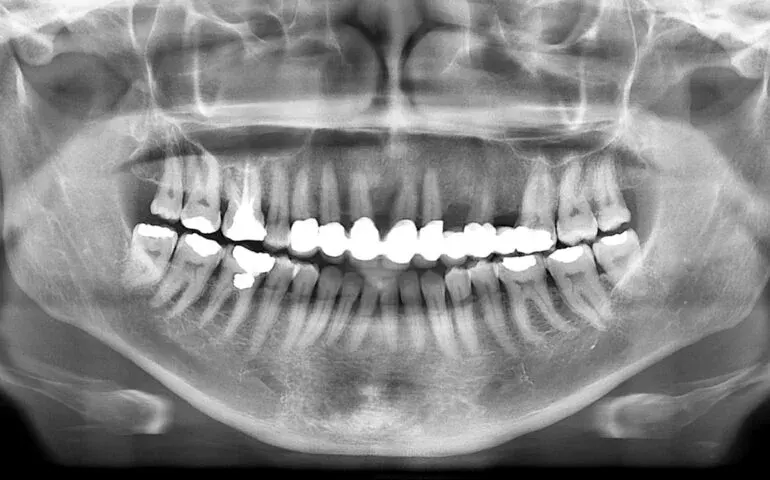
A panoramic X-ray shows the jawbones, the teeth and pathologies of the jawbones on a single image.

A panoramic X-ray is a two-dimensional dental X-ray that shows all the teeth in the upper and lower jaws, the jawbones, the jaw joints and the lower part of the sinuses in a single image. Because it fits the whole mouth into one image, it helps detect many problems, from impacted teeth and bone loss to inflammation at the root tips and jaw cysts.
At our clinic in Teşvikiye, Nişantaşı, panoramic X-rays are taken as part of the examination and treatment planning, when the dentist considers them necessary. On this page you can find out when a panoramic X-ray is needed, how it is taken, what it does and does not show, and how safe it is.
When is a panoramic X-ray taken?
- At the first examination, to assess the general condition of the mouth
- To see the position of wisdom teeth and impacted teeth
- In the first stage of implant planning
- Before and during orthodontic treatment, to monitor the teeth and roots
- To follow the development of permanent teeth in children
- When jaw cysts, bone loss or trauma are suspected
What does it show, and what does it not?
A panoramic X-ray gives a general map of the mouth: it provides information about the number of teeth, impacted or missing teeth, the condition of the roots, bone levels, large cavities and root-tip inflammation, cysts and the jaw joints.
However, because it is a two-dimensional image with limited detail, it does not show everything. For small cavities between the teeth, intraoral (periapical or bitewing) X-rays are more suitable. When the width of the bone or the distance of a tooth from a nerve needs to be assessed in three dimensions, a CT scan may be needed; in that case you are referred to an imaging centre.
How is it taken?
- Metal items such as necklaces, earrings, glasses, hair clips and removable dentures are taken off.
- You are given a protective apron.
- You stand or sit in the machine and bite on a small piece with your front teeth.
- During the scan, the machine rotates around your head for about 10–20 seconds; you need to keep still during this time.
- The digital image is ready on screen shortly afterwards, and your dentist goes through the result with you.
No special preparation is needed and the procedure causes no discomfort.
Is it safe?
The radiation dose of a digital panoramic X-ray is low; it is close to the radiation we receive from natural sources over a few days of everyday life. Even so, X-rays are only taken when necessary and on the dentist's decision. If there is any chance you are pregnant, be sure to say so before the scan; X-rays are generally postponed during pregnancy, and in emergencies they can be taken with the necessary protection.
Panoramic X-rays in children
In children, panoramic X-rays are used to see the number, position and stage of development of the permanent teeth growing beneath the baby teeth. This allows conditions such as missing or extra teeth, teeth at risk of becoming impacted, or baby teeth that do not fall out on time to be noticed early, and preventive orthodontic treatment to be planned if needed. In children too, X-rays are only taken when necessary and with the lowest dose; the procedure is explained to the child beforehand so that they can keep still during the scan.
What are the results used for?
A panoramic X-ray allows problems that cannot be seen during the examination to be detected and treatment to be planned correctly. The images are archived, so changes over time (progression of bone loss, healing of a cyst, tooth development in children) can be compared. It provides some of the basic information for planning tooth extractions, root canal treatment, implants and orthodontic treatment.
For questions about panoramic X-rays, you can book an examination at our clinic in Nişantaşı or message us on WhatsApp.
Frequently asked questions about Panoramic X-Ray
Is a panoramic X-ray harmful?
The radiation dose of a digital panoramic X-ray is low. Even so, it is only taken when necessary and on the dentist's decision. If there is any chance you are pregnant, be sure to say so before the scan.
What is the difference between a panoramic X-ray and a CT scan?
A panoramic X-ray shows the whole mouth in a single two-dimensional image. A CT scan gives a three-dimensional image and may be needed for detailed assessments such as implant planning or the relationship of impacted teeth to a nerve.
Can a panoramic X-ray be taken during pregnancy?
X-rays are generally postponed during pregnancy. In emergencies, when the dentist considers it necessary, they can be taken with protective measures.
How often should a panoramic X-ray be taken?
There is no fixed required frequency; the dentist takes one when it is considered necessary, based on the examination findings and the planned treatment. If you have recent X-rays, it is helpful to bring them with you before a new one is taken.